Dry ice is often treated as something out of science fiction, but it's a real, practical substance with real-world applications. Here's everything you need to know about what it actually is, how it behaves, and how to use it safely.
Not sure how much you'll need? Our dry ice calculator estimates the right quantity for your cooler, shipment, or event in seconds.
What Is Dry Ice?
Dry ice is the solid form of carbon dioxide (CO₂), and it behaves very differently from regular water ice. Instead of melting into a liquid, dry ice sublimates — it turns directly from a solid into a gas. That property is what creates the foggy effect you've seen in movies and on stage.
What Is the Chemical Formula of Dry Ice?
The chemical formula for dry ice is CO₂. It's the solid form of carbon dioxide, and it sublimates directly from solid to gas at -78.5°C (-109.3°F) under normal atmospheric pressure.
What Is Dry Ice Composed Of?
Dry ice is composed of frozen carbon dioxide — the same gas humans exhale when breathing. Unlike regular ice made from water, it forms when CO₂ gas is cooled to around -109°F, at which point the gas turns directly into a solid.
Dry ice doesn't melt into a liquid the way regular ice does. It sublimates — changing straight from a solid to a gas — which is exactly why it produces that spooky, foggy effect as it disappears into the air.
How Dry Ice Is Made
Dry ice is made by compressing and cooling carbon dioxide gas until it liquefies. That liquid CO₂ is then rapidly expanded, which freezes it into a snowy substance. That snow-like CO₂ is then pressed into blocks or pellets — the forms you'll actually see for sale.
Can Dry Ice Melt?
Technically, no — dry ice doesn't melt like regular ice. It sublimates, turning directly from a solid into a gas without ever becoming liquid, at -109.3°F (-78.5°C). That's why it vanishes as carbon dioxide gas rather than leaving water behind. How fast that happens depends on temperature, ventilation, and the size of the piece. To make it last longer, keep it in an insulated cooler — never in an airtight container, since pressure builds up as it sublimates.
The Temperature of Dry Ice
Dry ice sits at -109.3°F (-78.5°C), far colder than regular ice. That extreme cold is what makes it effective at freezing items and keeping them frozen through transport — a big reason food and medical industries rely on it.
Density of Dry Ice
Dry ice has a density between 1.2 and 1.6 kg/dm³, considerably denser than water ice — which is why it sinks in water rather than floating, and why it creates such dramatic fog when submerged.
Rate of Dry Ice Sublimation
Sublimation speeds up with more heat and airflow. In general, dry ice sublimates at a rate of about 5 to 10 pounds per 24 hours in a standard cooler. For longer storage, account for that loss and adjust your quantity accordingly.
The Science Behind Dry Ice
The ability of dry ice to sublimate comes down to its chemical composition and atmospheric pressure. A simple experiment — dropping dry ice into water — is enough to demonstrate the effect, producing the dense, fog-like cloud it's known for.
Uses of Dry Ice
Dry ice shows up across food preservation, where its cold keeps items frozen in transport; entertainment, where it creates atmospheric fog; and medical transport, cleaning, and scientific research.
Handling Dry Ice Safely
Handling requires caution given how cold it is. Always use protective gloves to avoid dry ice burns, store it in an insulated (never airtight) container, and let it sublimate in a well-ventilated area when disposing of it.
Paper Bag or Plastic Bag for Dry Ice
A paper bag is the better choice for handling and transport — it insulates while still allowing enough airflow to prevent CO₂ buildup from sublimation, which lowers the risk of pressure buildup. Plastic bags can trap that gas and expand or rupture, which is a real safety hazard. An insulated container built for dry ice is the safest option overall.
Does Lab-Grade Dry Ice Carbonate Fruit?
Yes — lab-grade dry ice can carbonate fruit, giving it a fizzy quality. The CO₂ released as it sublimates gets absorbed by the fruit. To do this safely, place small pieces of food-safe, lab-grade dry ice in a vented, sealed container with the fruit, so pressure doesn't build up while the CO₂ infuses into it.
Fun Facts About Dry Ice
- Also known as "cardice" in some circles
- Under high pressure, dry ice can become liquid
- Its existence was first documented in 1835 by French chemist Charles Thilorier, after a container of liquid carbon dioxide was opened
- It's called "dry" because it sublimates, skipping the liquid phase entirely
- It may look like regular ice or snow, but it's far colder to the touch
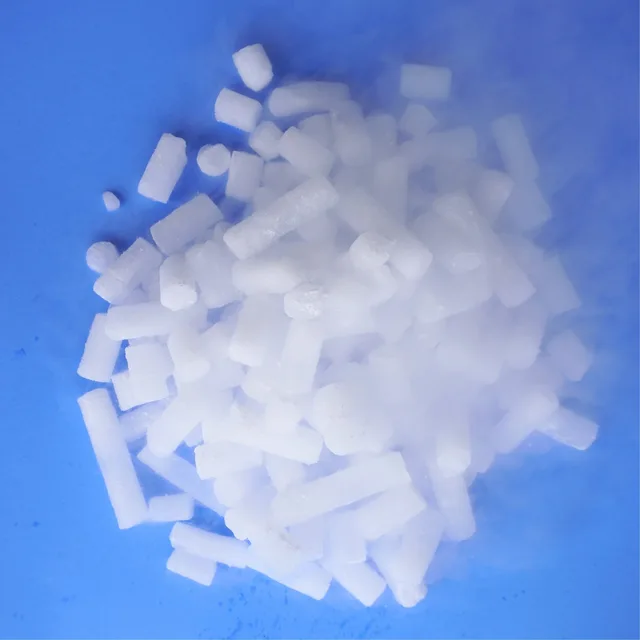
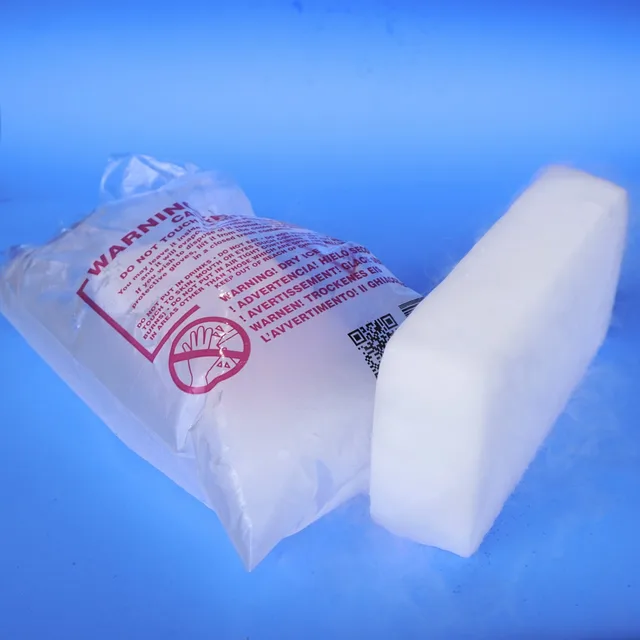
- It's typically sold as pellets or blocks
- Its density ranges from 1.2 to 1.6 kg/dm³, denser than water ice
- Its molecular weight is 44.01 g/mole
- It has low thermal and electrical conductivity, making it an efficient insulator
- As a nonpolar substance, it has a dipole moment of zero
- It sinks in water because of its density — its specific gravity is 1.56
- The white vapor it produces is mostly water fog, mixed with carbon dioxide
- In areas with heavy dry ice use, ambient CO₂ concentration rises
- Without proper care, handling it can cause frostbite or dry ice burns
- It can displace air with CO₂, creating an environment where you inhale more carbon dioxide than oxygen
- Eating or swallowing it is dangerous and can cause internal frostbite
- Skin contact can kill skin cells, causing real injury
- Sealing it in an airtight container risks explosive pressure buildup
- It's especially useful in places without mechanical cooling
- Industrially, it's used for cleaning through dry ice blasting
Dry ice is more than a smoky novelty — it's a genuinely useful tool across a wide range of fields. Handle it with the respect its temperature demands, and it opens up a lot of possibilities.