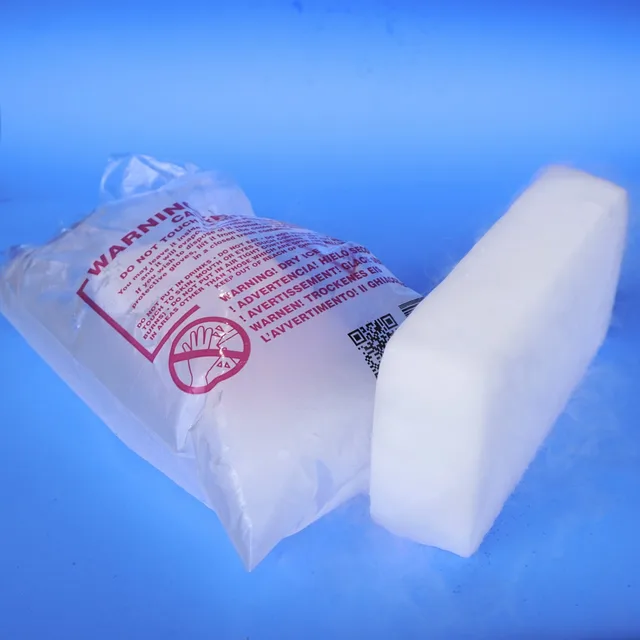
Dry ice, with its dramatic fog and extreme cold, comes with more misconceptions than most household substances. Here's the truth behind eight of the most common ones.
Not sure how much you'll need? Our dry ice calculator estimates the right quantity for your cooler, shipment, or event in seconds.
Myth 1: Dry Ice Melts Like Regular Ice
Unlike regular ice, dry ice doesn't melt into water. It sublimates — converting directly from solid to gas. It's a solid form of CO₂, pressed into white blocks or pellets at very low temperatures, and that residue-free property is exactly why it suits applications where a liquid byproduct isn't wanted.
Myth 2: Dry Ice Can Be Consumed
Dry ice cannot be eaten. At -78.5°C (-109.5°F), it causes instant frostbite to mouth tissue on contact. If swallowed, it can cause severe internal burns and lead to serious complications like gastric perforation or asphyxiation.
Myth 3: Dry Ice Has Limited Uses
Beyond cooling, dry ice shows up in entertainment for special effects, and in industrial cleaning through dry ice blasting — a genuinely versatile substance across several industries.
Myth 4: Inhaling Dry Ice Is Harmless
Storing dry ice in a poorly ventilated space exposes people to elevated CO₂ levels that can displace oxygen. Effects range from headaches and confusion to disorientation, and in extreme cases, it can be fatal. That's why well-insulated, non-airtight containers and proper ventilation matter during both transport and storage.
Myth 5: Dry Ice Works as an Air Conditioner
Using dry ice for air conditioning doesn't hold up in practice. CO₂ accumulation causes dizziness and headaches, the cooling effect isn't sustained the way a real system delivers it, and continuously replacing the dry ice gets expensive fast. It's genuinely useful for coolers and fog production, but it's not a substitute for air conditioning.
Myth 6: Store Dry Ice in a Freezer to Make It Last Longer
This is both dangerous and counterproductive. Dry ice sits at -109.3°F (-78.5°C), far colder than a standard freezer (around 0°F/-18°C). Putting it in a freezer tricks the thermostat into shutting the compressor off early, thaws other food in the process, can mechanically damage the appliance, and creates a pressure and suffocation risk as the CO₂ sublimates in an enclosed space. Instead, store it in a cooler built specifically for dry ice — it typically holds for 18 to 24 hours, depending on block size and how often the cooler gets opened.
Myth 7: You Can Touch Dry Ice Bare-Handed
Direct contact with bare skin causes frostbite within seconds. At roughly -109.3°F, handling dry ice with bare hands isn't a good idea under any circumstance — the immediate consequences are burns and real tissue damage. Always use tongs or protective gloves.
Myth 8: Dry Ice Can Be Disposed of in the Trash
Discarding it down a drain is dangerous — there's a real risk of a burst pipe if dry ice gets lodged at a high-pressure point. Safe disposal means an open, well-ventilated outdoor area, away from pets and children, left in its original packaging on a towel to sublimate naturally.
Can You Freeze Dry Ice?
Dry ice is already frozen solid under standard pressure. Trying to freeze it further wouldn't change its state — it would simply remain solid carbon dioxide until it sublimates into gas. To get the most out of it, use insulated containers, keep it properly ventilated, and keep it away from direct sunlight and heat.
Dry Ice Mosquito Traps
Dry ice mosquito traps work by attracting mosquitoes with the CO₂ it releases, mimicking the scent of a potential host's breath. It's used in both residential pest control and scientific research, and stays effective for several hours when placed correctly in shaded areas.
Dry Ice Cooling: Effective Temperature Management
Dry ice cooling holds the low temperatures that matter to food, pharmaceutical, and medical industries — keeping perishables and frozen food solid in transport, and protecting temperature-sensitive vaccines and medications along the way. As always, that means well-ventilated storage, no airtight containers, and protective gloves to prevent frostbite. See our guide on storing dry ice for the full detail.
What Happens If You Touch Dry Ice?
Direct contact causes frostbite — a cold burn where skin cells freeze and get damaged, much like skin reacting to a very hot surface. Even brief contact causes red, blistered skin, and prolonged exposure leads to deeper damage with the potential for long-term effects. Always use insulated gloves or tools when handling it.
Dry ice is safe and genuinely useful once you know the real rules — and most of what trips people up comes down to exactly these eight myths.