Photo: CIRES Photos (CC BY)
Dry ice shows up everywhere from shipping perishable goods to special effects at events, but few people know how it’s actually produced. Here’s the process behind it, its properties, and why it’s so useful across so many industries.
Not sure how much you'll need? Our dry ice calculator estimates the right quantity for your cooler, shipment, or event in seconds.
What Is Dry Ice?
Dry ice is the solid form of carbon dioxide (CO₂). Unlike regular ice made from water, it doesn’t melt into liquid as it warms — it sublimates, turning directly from solid to gas. That’s what makes it such a good cooling agent: no residue, no mess. Its temperature sits at an extreme -109.3°F (-78.5°C), which is why it keeps items frozen for far longer than regular ice.
Step 1: Sourcing Carbon Dioxide (CO₂)
The first step is sourcing CO₂, the raw ingredient. It’s a naturally occurring atmospheric gas, but for production it’s usually collected as a byproduct of industrial processes like ammonia and ethanol production — which reduces waste while efficiently capturing the gas for use.
Step 2: Liquefying the Carbon Dioxide
Once collected, the CO₂ is pressurized and cooled to shift it from gas to liquid. It’s compressed and cooled to below -69°F (-56°C) under high pressure, at which point it becomes liquid — the state needed for the next stage.
Step 3: Expanding the Liquid CO₂
The liquid CO₂ is then rapidly expanded into a much lower-pressure environment. As pressure drops, the CO₂ expands and partially evaporates, triggering a sudden temperature drop that turns the liquid into a mix of gas and solid CO₂ snow — cold, fluffy, and resembling powder. This snow is the initial form of dry ice, ready for compression into blocks, pellets, or slices.
Step 4: Compressing and Shaping the Dry Ice
Once the CO₂ snow forms, it’s collected and compressed with hydraulic presses into different shapes.
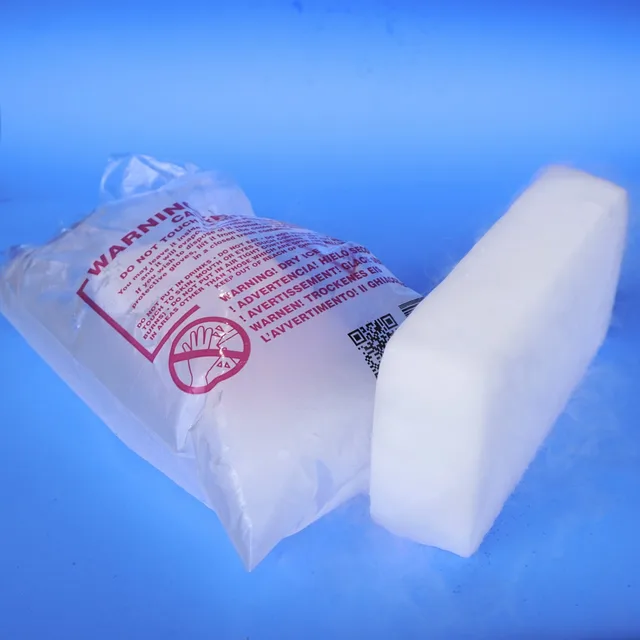
- Dry ice blocks: made by compressing CO₂ snow into large molds, used for industrial applications and large-scale refrigeration.
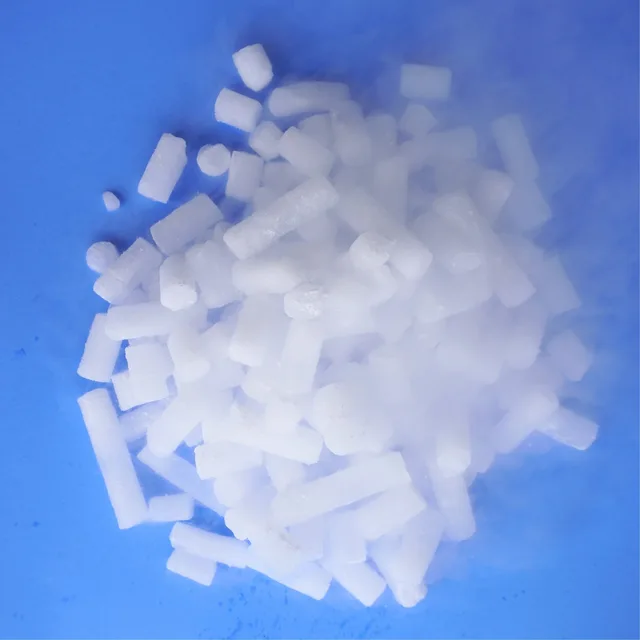
- Dry ice pellets: the snow is fed into a pelletizer and compacted into small, cylindrical pellets — ideal for dry ice blasting, fog machines, and small-scale cooling.
- Dry ice slices: made by compressing the snow into thin sheets that can be cut or shaped as needed.
Step 5: Storing and Transporting Dry Ice
After it’s shaped, dry ice needs to be stored and transported carefully to hold its extremely low temperature and slow sublimation. Specialized insulated containers or coolers keep it cold during transport. Because it sublimates directly into CO₂ gas, storage areas need proper ventilation to prevent gas buildup, which can be hazardous in confined spaces.
Why Is Dry Ice So Useful?
The process is efficient, which is part of why dry ice is so valuable across industries.
- Refrigeration and shipping: widely used in food and medical industries to keep vaccines, pharmaceuticals, and perishables cold during transport, without melting into liquid.
- Special effects: a favorite in entertainment for dense, low-lying fog — add it to warm water and it produces thick fog for theatrical effects, parties, and haunted attractions.
- Dry ice blasting: in industrial settings, pellets clean equipment and surfaces by shrinking and detaching contaminants — effective and environmentally friendly.
- Science experiments: its unique properties make it a staple in educational settings for demonstrating sublimation, gas expansion, and other principles.
How Do You Make Dry Ice at Home?
Industrial dry ice is produced at scale with specialized equipment, but it’s possible to make a small amount at home with access to liquid CO₂ — commonly found in fire extinguishers or CO₂ tanks for soda-making. This does require proper safety gear, since the process involves extremely low temperatures. Here’s the basic rundown:
- Work in a well-ventilated area to prevent CO₂ gas buildup.
- Wear insulated gloves and eye protection.
- Attach a fabric bag or sock to the nozzle of a CO₂ fire extinguisher or tank.
- Release the CO₂ slowly into the bag — it will expand, cool rapidly, and form dry ice snow.
- Gently collect the snow and compress it into small pieces.
Safety matters here: improper handling of CO₂ and dry ice can lead to severe frostbite or respiratory issues from gas exposure.
Conclusion
Turning carbon dioxide gas into a versatile cooling agent is both a fascinating and efficient process. From sourcing and liquefying CO₂ to compressing it into blocks, pellets, or slices, it’s a good example of science and industry working together. Sub Zero Dry Ice specializes in providing high-quality dry ice blocks, pellets, and packaging services for shipping, special effects, or industrial use.